Showing posts with label Happiness. Show all posts

Friday, October 9, 2015

Empty Symbols

Symbols are important.  They serve as a means of communicating a powerful message in a way accessible to people without reliance on language.  They represent something complex, and make it more accessible.  They reach us on an emotional level and serve as a rallying point.

But the symbol of a thing is not the thing iteself.

There is nothing wrong with wearing a pink ribbon, buying the pink yogurt, or walking a 5K to support breast cancer.  The pink ribbon has become a very powerful symbol for women's health.  But the symbol of the thing is not the thing.  That pink sweatshirt does everything to make you feel satisfied with your social consciousness, and NOTHING to advance women's health.

What does support women's health?  Planned Parenthood.  Local free clinics.  Universal health care.

There is nothing wrong with Georgians coming up with $44,000 to paint a set of crosswalks rainbow during Pride week via crowdfunding online.  But considering the level of rainbowfication in that neighborhood during Pride week, it does NOTHING to advance the rights and safety of gender and sexual minorities (GSM) in Atlanta.

What DOES advance the rights and safety of GSM in Atlanta?  Lost-n-Found Youth.  Non-discrimination laws protecting employment and housing.  Initiatives to prevent GSM targeted violence.

Organizations count on complacency for profit.  They know that if they can get you to cough up a few bucks for their product, you will get that warm fuzzy glow of self-esteem as value-added.  But it is vitally important that understand the difference between the symbol of the thing, and the thing itself. 

The thing itself sometimes takes more effort than whipping out your wallet (although donating directly to helping organizations is a good start).  It means writing your elected officials.  It means signing petitions.  It means standing up to people who say things you know are wrong.  It means re-arranging your own thinking on important issues affecting vulnerable populations. 

Now that awareness of pink-washing and rainbow-washing are going mainstream, it will be more and more difficult for you to buy your complacency.  You might want to find out for yourself that the warm glow you get from actually making a difference is much warmer than the self-congratulation of supporting a fresh coat of paint on the street where our kids are living homeless. 

Friday, November 23, 2012

Turkey Day

Due to a shared respiratory bug and a tight work schedule, JD and I ended up spending Thanksgiving with just each other for company.  That's actually okay; we haven't had enough of that lately :-)  I found myself thankful for many things, but especially for being able to eat, without shame, the holiday food I remember from my childhood.  Part of that is FA and getting rid of the baggage and apocalyptic thinking around holiday food.  Even at a time when we're supposed to be celebrating we have magazines, commercials and sometimes family heaping on remorse and stress for food choices.  Part of that is my recent gluten-free recipe discoveries and experiments.  After three years without my favorite Thanksgiving dish (stuffing) I was able to put it on the table, along with rolls and pumpkin pie with a crust.  The prep was a little more work, but I was able to sit down with my life partner and eat a traditional Thanksgiving meal without any reminders of food restriction or guilt.  I'm thankful for that, because I know not everyone who experiences the holiday does so with enough food, or with supportive people, or with good memories.  I haven't always done so either.   This year was good. 

And by the way, for those who want to know, I used this recipe for the stuffing base and rolls (the stuffing requires about 1/2 cup more broth than you would normally use, 'cause GF soaks up the liquid) and this recipe for the super-flaky, delicious pumpkin pie crust. 

Saturday, November 3, 2012

The Other Kind of Diet

We talk a lot in FA about diets.  In general, we mean diets that restrict food in an attempt to lose weight.  However, everyone has a diet.  It is a term referring to what foods you eat.  It's difficult for me, however, to shake the association with restriction, and all the triggering scarcity thinking and food-obsession a weight loss diet entails.

When I first entered FA, I went through the period most people do, where I ate a lot of the foods I had denied myself in the past.  Once I convinced myself that it was okay not to diet, I satisfied frequent cravings for ice cream, pastries, fried foods, and all the other foods assigned negative moral values in our diet culture.  After a lifetime of scarcity thinking, I had to prove to my body and brain that I really could eat these things whenever I wanted.  I wasn't going to suddenly take them away again.  I was actually going to listen to what my body needed.  The only way to prove that was to acknowledge my cravings and fulfill them when they happened.

After a while (about 6 months to a year) my body was finally convinced that I wasn't pulling a bait and switch.  The food really was going to be available and I really could have it when I wanted.  My body started to trust me again.  The intense cravings stopped, and I began to actually want a varied diet with food that was good for me.  Healthy eating went from a form of punishment (during my dieting periods) to a form of self-care. 

Now, my life partner has Celiac disease.  For him, a healthy diet restricts any food containing gluten.  It also restricts all fast food and most restaurants.  Even restaurants with gluten-free menus have often made him sick from minor cross-contamination in the kitchen. 

Then there's me.  Bread and baked goods have always been a major staple in my life.  I've often said that I could live for months on nothing but good bread and cheese and be perfectly happy.  If left to my own devices, my ideal meal would be a whole-grain baguette and a wedge of imported cheese, maybe with some wine.  Entering into a relationship with a person who gets extremely sick from even the slightest exposure to the major part of my diet has required some adjustments. 

We have tried to compromise where I can eat gluteny food when I'm not in the house or with him.  It involves careful clean-up including a change of clothes, brush and floss, and face scrub. Even then, there is a period of about 24 hours where the particles of gluten in my mouth make it unsafe for him to kiss me.  That is the worst part.  I can go out to a restaurant with friends but afterwards I have to spend a day and night actively avoiding kissing the person I love.  I have to keep my glass and eating utensils separate.  I risk making him sick every time I touch him, in case I have unconsciously touched my mouth.

You would think, considering all this, that it would be an easy decision to go entirely gluten-free myself.  It may have been an easier decision had I not spent most of my life betraying my body with an unhealthy relationship with food.   It might be easier if I were gluten-intolerant myself, because he has developed unconscious aversions to the foods that made him sick, even as a child when he had no idea what was really wrong. 

To me, giving up gluten feels exactly like weight-loss dieting.  It means I cannot eat intuitively.  It means scarcity thinking, anxiety spikes, deprivation and unfulfilled cravings.  Can I convince my body that I'm not betraying it by denying it familiar foods? 

Recently, we both discussed it and decided that I was going to try to go entirely gluten-free myself.  He has had a few gluten exposures since we moved, and he cannot afford the time and progress lost when he's working 12 hour days in graduate school.  I should say we cannot afford it, because the whole point of us coming to Atlanta was to make that happen for him.  The risk is too high.

At his end of the compromise, however, he is working really hard to make sure I can make foods available that fulfill my cravings.  In a lot of ways this feels like coming into FA all over again.  When I started missing belgian waffles, he made sure we could get a waffle maker and I started looking up recipes.  (This one is the best we've found so far).  We got a stand mixer so that I could do better breads and cakes.  We got a toaster so that I could make gluten-free bagels and toast them to be as authentic as possible.  He doesn't argue when I say we need to get something that will help me transition.

It does feel just like going off weight-loss diets.  I have anxiety and scarcity thinking.  I get stressed over foods I can't have.  I've probably eaten a waffle every day this week just to prove to my body that I can have them whenever I want.  I made three batches of cookies with the new stand mixer, and two dozen bagels in the last two weeks.  I'm eating far more bread products now than I did before we decided to both go gluten-free.

The difference is that I've been through it before.  I know that if I just take care of my body, let it work through cravings, and prove that I can still give it what it needs, that my eating habits will return to normal.  The cravings will ease.  Any weight I gain (probably minimal) in the meantime will go away as my body adjusts my energy levels and sends me different food messages.  Most importantly, my body will trust me again.  And considering the risks and benefits, it's worth it. 

Tuesday, October 9, 2012

The Four Agreements of Body Acceptance (Part 4)

This is part Four of my series applying the concepts from the book "The Four Agreements" by Don Miguel Ruiz to self acceptance and body acceptance.  You can read the previous parts here: 

Part 1
Part 2
Part 3

Part 4

Fourth Agreement:  "Always Do Your Best" (Don Miguel Ruiz, "The Four Agreements")

The key part of this agreement is the idea that your best is not a constant, because you are not a machine.  It is okay if your 100% today is very different from your 100% last week.  It is important that you give yourself credit for what you can do today.  In body acceptance, your best today might be going to a protest rally, shaming the haters, standing up to every body-negative message you encounter.  On the other hand, your best might be getting through your day without actually killing someone. 

Christine Miserandino is a writer who came up with what's now called the "spoon" theory.  She was using the analogy to describe the very limited energy available to her as someone living with Lupus, but it has since been adopted by many auto-immune and pain disorder sufferers including those with Fibromyalgia and Celiac. She described her day to a friend in a cafe' in terms of a handful of spoons.  Each activity in her day costs her one or mores spoons, from waking up and showering, to doing the dishes, to dealing with a friend's trouble.  At the end of the day, with one spoon left and many different people and chores bidding for it, she has to make serious choices about what she is capable of accomplishing and what she needs to let go. 

The spoons, of course, represent a unit of energy.  The energy can be any combination of physical, mental, and emotional energy depending on the person and the day.  You may have days when your brain is going a mile-a-minute but you are too physically exhausted or emotionally overwhelmed to really act on your trains of thought.  Or, you may be physically restless but feel like you're thinking through a fog.  If you do suffer from a disorder that saps your physical and emotional energy, the number of "spoons" you can allot to loving and accepting your body may be very limited. 

But everyone, whether or not they have an identified disorder, does have a finite amount of physical, mental and emotional energy each day. Through media, ads, and societal pressure we are sometimes fooled into thinking that it's possible to go through life giving the same or greater smiling 100% every day without fail or discouragement. I have never personally met or heard of a person with no off-days. Have you? I have some days when I feel like I can conquer the world, write a novel and declutter the house in the same afternoon.  On those days, body acceptance is easy.  I can laugh off negative body messages with scorn and engage the haters with cool confidence.  I have other days when a casual fat joke in a television show or a billboard for bariatric surgery will send me into a dark, unshakable, pessimistic funk for the rest of the day.  On the latter days, my best is to simply be forgiving of myself, avoid shaming messages as much as possible, and seek out support from loved ones.  Most days are somewhere in-between.  I suspect that's fairly typical. 

So in deciding to yourself what your "best" effort is towards body acceptance, be careful of setting static or absolute goals for each day.  People with pain disorders know that they often don't know when a flare-up will arrive until it does, and the rest of us could wake up any morning with a cold, a bad night's sleep, or generally an inexplicably crappy mood. The discouragement of not reaching a goal is the worst possible addition you can make on an already discouraging day.  Instead of saying "tomorrow I will accomplish XYZ," it might be helpful to set a sliding scale of goals, where you include some body-love activities that come very easily to you and some that are more difficult.  That way, you can decide how much you do based on what you actually can do. On a low-energy day, reward yourself for the little things.  On a high-energy day, tackle something bigger.  Either way, you find something to feel good about.  Just be honest with yourself about what constitutes your best. 

Tuesday, September 18, 2012

The Four Agreements of Body Acceptance (Part 2)

This is part two of my series applying the concepts from the book "The Four Agreements" by Don Miguel Ruiz to self acceptance and body acceptance.  You can read part one here: 

http://unapologeticallyfat.blogspot.com/2012/09/the-four-agreements-of-body-acceptance.html

Part 2

Second Agreement:  "Don't Take Anything Personally" (Don Miguel Ruiz, "The Four Agreements")

This is a huge struggle when it comes to body acceptance. Face it, humans are social creatures and we may even be biologically wired to seek the approval of others.  It becomes even more difficult when someone who you should be able to count on for acceptance (parent, child, lover friend) voices negative criticism of your body or self expression. 

The psychological concept behind this agreement is Humanistic and has to do with each person having their own personal mythology, or story, that defines our self-concept based on our values, experiences, and goals. Part of that mythology is that we assume, on an almost unconscious level, that other people share our story, experiences, tastes, dreams, and opinions.  That is why seeing things from another person's point of view becomes more difficult the more that view differs from our own.

If someone's personal "hero quest" is to reach a certain aesthetic ideal, they are quite often quick to assume that everyone shares in and approves of that goal (or that they should do so).  It helps when the aesthetic ideal is culturally reinforced through the media and arts.  But the fact that a lot of people share a particular mythology doesn't make that mythology true for you.  You have your own, and it is just as true as the mythology of the fashion marketing world. 

Understanding where that criticism comes from is a big step in deflecting it. It becomes easier to understand when put in terms of clothing, because our ability to change our clothing makes our fashion image less emotionally fraught than our body image. Let's say that you're part of the biker culture.  You wear a leather vest, jeans or leather pants, body art, maybe even piercings.  Your very preppy parents ask you constantly (for your "own good") why you can't dress more "respectably."  Our culture reinforces that your style is unlikely to bring you wealth or status.  You may be rejected by potential partners who make assumptions about you because of your clothing.  You get sideways stares in restaurants and malls.

Whose problem is this? 

Our society, and individuals who disapprove of your image would like you to think it is your problem and any negative effects your fault.  In truth?  They are the ones responsible for their own minds and actions.

It is NOT your responsibility to live up to someone else's mythology or expectations.  As a friend once said, "what other people think of me is none of my business."  Your only responsibility is to determine and live up to your own mythology or self-concept. 

Make it part of your mythology that there is nothing wrong with your body or the skin you're in.  That acceptance changes reality for you.  The more certain you can be, the more you are insulated from other peoples' fear.  Because if someone reacts negatively to your body, it is most likely because they have fear.  They may fear experiencing (even tangentially) the stigma of a body shape that does not fit the popular cultural ideal.  They may fear aging and mortality.   They may fear judgement from others.  They may fear some ghost of an experience inside their head that has absolutely nothing to do with you. 

But it is THEIR fear.  You don't have to own it, and you certainly don't have to support it.  It is not your responsibility to be universally appealing or well liked.  If their fear keeps them from having a relationship with you, then you will find other people without fear.  You don't need to engage in scarcity thinking where you examine where you have failed in obtaining approval from this one particular person.  There are billions upon billions of people in the world, and among them are people who would approve of you as you are right here and now. 

That's what it means to not take it personally.  Your mother's concern about your appearance is fear that she cannot make your life free of pain and judgement from others.  That stranger's derisive comment is their fear of becoming or being something else, or bitterness that they are no longer something they liked.  You can choose to pity the person, or educate them, or ignore them.  The only wrong choice is to take on their fear and use it to hurt yourself. 

Tuesday, September 11, 2012

The Four Agreements of Body Acceptance (Part 1)

While I'm not a big fan of the writing style and New Age mysticism of the book "The Four Agreements" by Don Miguel Ruiz  the core concept of each agreement applies well to body and self-acceptance.  Some people can really identify with the book, but for those of us who can't,  this is a series of posts distilling it down to the practical. 

Part 1

First Agreement:  "Be Impeccable With Your Word" (Don Miguel Ruiz, "The Four Agreements")

The concept here is based in the idea that you are what you do, and that speech is action.  Every time you speak negatively of your own appearance or that of others, you internalize that negativity and it becomes part of you.

What we often don't realize is that the words we say in our heads may not have the same impact as what we say aloud, but it does have an effect and there tends to be much more of it.  We're taught that it's rude to say negative things, so we say them silently, and to ourselves, and more or less constantly.  Most people are not even aware of the sheer volume of negativity in our lives; it has become normal background noise. 

Wrapped up in the problem is that we tend to suspect in others the actions we are most ashamed of in ourselves.  When you keep a running monologue of criticism of other peoples' bodies, it makes it easy to believe that others are doing the same about our body.  From that comes shyness, body shame, and self-criticism around other people. 

Being "impeccable with your word" means watching what you say to yourself as well as to others.  Each time you find yourself criticizing or reacting negatively to someone's body (your own or someone else's), see if you can cut yourself off.  It's okay to simply tell yourself No. 

Of course, trying to not think about something is extremely difficult for our brains.  There's the old playground trick where you dare someone to not think about pink elephants.  The only way it's possible for most people is to try very hard to think about something else.  So when you catch yourself in a negative thought, deliberately substitute a positive thought. Find something about the person to compliment, or that is at least neutral.  If you can't, at least try to think about something else.  How's the weather?

Dialectic Behavioral Therapy is based on this very concept; that the thoughts, body and emotional state are interconnected.  Changing one can often affect the others (for good or ill).  By policing your negative thoughts, you can elevate mood and improve health.  These are the primary benefits of reducing stress in general, and negative body talk can be very stressful. 

This is something that no one can wave a magic wand and fix, but with effort you can begin to head off criticism at the pass.  Eventually you'll find that instead of having to force yourself to think good things about people, it will happen automatically.  The boost in confidence and happiness this brings is well worth the effort. 

Wednesday, August 15, 2012

Learn How to Fail


Take a look around at our culture’s media, and one of the many themes that emerges is that failure is the worst thing that can happen to you.  Celebrity mis-steps are made headlines;  fictional relationships explode over a single lapse in judgement; competitions are all or nothing. 

It is no wonder that mistakes and failures, large and small, serve as a considerable roadblock to our self-esteem.  We are programmed to beat ourselves up for small imperfections, agonize forever over a single social gaffe, and assume every single negative thing in our lives is the fault of our imperfections.

In self-acceptance it is vitally important to learn how to fail.  Every single human, no matter how successful or famous, makes mistakes.  It is what we do with our mistakes that defines us as a person and determines how we feel about ourselves.

Step 1:  Admit It

Admit that you made a mistake, both to yourself and anyone else affected.  You get bonus points for admitting your mistake as soon as you realize it exists, rather than waiting to see if it passes unnoticed or letting someone else take the fall.  You also get kudos for admitting your mistake without getting angry or resentful toward either yourself or others. 

The  point here is to accept how things are right now, in this time and place.  If you deny your mistakes, you are stuck in the past; you cannot learn from them or correct their effect.  You cannot give yourself a chance to really make it right and feel the associated boost in self-esteem of knowing you have handled something difficult with grace and dignity.

Step 2:  Apologize

Many people have it stuck in their head that any conflict should be treated like a game of chicken.  The first person to “back down” by apologizing loses the game (along with social status).  In reality, people tend to have much more respect for someone who can easily admit when they’re wrong.  After all, only a person who already has high status can afford to risk it by apologizing.   The people who can’t back down are those who fear any loss of status, which comes across to others as if they have very little to begin with. 

So apologize.  This is a separate step from the first one, so simply saying “I made a mistake” does not count as an apology (although it’s a good lead-in).  The best apology is simple; “I apologize” or “I’m sorry”.  Also, mean it (even if you have to think about it for a while first). 

Step 4:  Make Amends

When your mistake adversely affects someone (including you), it is important to make a sincere effort at amends.  This doesn’t have to be on an eye for an eye basis, but it should show some tangible willingness to compensate.  If you wreck someone’s car, there is no reasonable expectation that you will buy them another (unless you can easily afford it).  A reasonable effort at making amends could be volunteering to drive them to important appointments, paying for the tow truck or insurance deductible if you can afford it, or even offering to cook them dinner or clean their house since they may have less free time or money because of the accident.  In other words, make it relevant, thoughtful and timely. 

Don’t  make it about you.  If they really don’t want you to cook for them, showing up on their doorstep with endless casseroles is not helping them.  It is only serving you make you feel better.  Find out what they actually need and what they might appreciate.  Part of the thoughtful effort is a consideration of how they feel and what they need. 

Remember that you need to make amends to yourself as well.  If you are beating yourself up for a private mistake, do something meaningful to cheer yourself up.  If you’ve slipped into body-bashing, take a few minutes to repeat some affirmations, experience movement, or something else constructive towards self-acceptance. 

Step 3:  Learn From It

Mistakes are not indelible.  You can make a serious dent in your self-esteem by dwelling on past mistakes.  Like any other negative thing in life, mistakes may require some closure to put behind you.

This doesn’t mean brushing off mistakes so that you repeat them indefinitely.  It may mean considering ways to avoid similar mistakes in the future (if possible).  It may mean practicing something in more detail.  It may simply be considered an opportunity to handle it well after the fact. 

It also doesn’t mean that you should beat yourself up twice as hard if you make the same mistake again.  A repeat may mean you need to pay closer attention at how to prevent the mistake, but it isn’t a sign of personal weakness.  Successful business owners often fail at several ventures before they find their niche.  Successful athletes fail at something many times before they perfect it.  When I was learning to ride, I was told I wasn’t a “real” horseperson until I’d hit the ground (unintentionally) at least twenty times.  Mistakes happen.  Each one is an opportunity, not a final judgement. 

So be willing to fail.  You can not only mitigate its negative effects in your life, but also turn it into a constructive experience that boosts your self-esteem and personal growth. 

Here are the steps in action:

Out loud to someone affected by the mistake, or internally if only you are affected:

“I made a mistake.”
“I’m sorry.”
“Is there any way I can make it up to you?  Would you let me do (XYZ)?”

Then, internally:

Is there any way I could have avoided making this mistake? 
What could I do differently next time? 
Did I handle this well?  How could I have done better?
What did I learn about myself or the process?

Most Importantly:
I forgive myself. 
I am proud of myself for what I did right in handling this mistake. 

Thursday, March 1, 2012

Stop and Admire the View

There’s a term in the field of psychology called disavowal, which means that you know something – but at the same time, you don’t let yourself know that you know it. In other words, you disavow the thing that’s too hard to consciously acknowledge.

I see this frequently when it comes to body acceptance. It is almost a distinct stage. Once you come to terms with the idea that body acceptance is a good thing, you become stuck on the idea that it is only a good thing for other people. You strongly believe that your friends, family and everyone else you care about should love and accept their bodies as strong, beautiful and just right how they are. But when it comes to your own body, somehow, it's different. There has to be some fundamental flaw that makes your body not okay, even if it's the only body in the world that isn't.

Let me just tell you, and ask you to repeat to yourself over and over again: There is nothing different about your body. You are not an exception. You deserve to love yourself every single bit as much as your friends and family deserve to love themselves, right now, just as you are.

Disavowal is a tough thing to work through because it involves shifting your own paradigm. Your brain and body like things how they are. It's called homeostasis. It's why you return to the same weight range if you try to stray too far out of it. It's why we cling to old ideas far more tenaciously than we embrace new ones. Change translates to stress in our physical bodies, because they must physically adapt to new ideas and circumstances.

It's also hard to outsmart yourself. Sometimes it's beneficial to "fake it 'till you make it," and see if it becomes a part of you after a while. Sometimes you just have to take the tiny voices firmly in hand and make that leap, which is only possible if circumstances are just right.

But, importantly, you are not alone if you are in this phase of FA. I have met very few people who were not where you are at some point in their journey. It is okay to be where you are. It is okay to stop and take a breather and re-assess where you are.

I can get into a pattern where I am driving myself so hard that I never stop to count accomplishments. I fall into scarcity thinking where I feel that if I lose momentum I will never get going again. But while I can't quite shake this belief in the moment (disavowal again) I inevitably find it to be false when I trust myself enough to stop. That's when I find that the mountain doesn't look so high from halfway up, and the view is already pretty good.

So let yourself be where you are on your journey to self-acceptance. Count your accomplishments so far, and enjoy the view. Later, you can take a deep breath and decide the next step from a less pressured position. In the meantime, you may find that you like yourself a little bit more for the steps you've already taken.


Tuesday, February 14, 2012

Giving Yourself Permission

I'm re-visiting the Fantasy of Being Thin with some friends right now, and thinking about when I gave up the one fantasy I had used as an excuse to hate my body.  When discussing this new round of examining all the people we would be if our bodies were different, JD used a key phrase that really stuck with me.  He said that you have to give yourself permission to be the person you want to be. 

He's right.  Right down inside all the fantasies is the idea that we have to conform to someone else's idea of perfect before we're "allowed" to live.  But there isn't an actual fashion police keeping me from baring my arms.  I don't have to ask permission from my friends to be confident.  Attractiveness isn't something given to you by others.

The year I blogged about my wild summer of giving up the "acceptable fatty" paradigm, I felt like I was really daring the disapproval of others by wearing tank tops and not covering up at the beach.  In retrospect, I realized that other peoples' disapproval wasn't really my problem.  They had no authority to tell me what was and wasn't okay to put on my body or show the world.  I was the only one who had that authority.  So what I was daring was my own disapproval.  What I was doing was giving myself permission.

Make a list of your fantasies...you know, the whole "when I am thin (or strong, or in less pain, etc.) I will be or do......" list.    How many of those things could you have right now, in the body you're in, if you give yourself permission?  Could you flirt more?  Dress differently?  Feel good about yourself?  Do more?  Do less?  How much of your fantasy is just you making your permission contingent on your weight or other physical attributes?  What is really stopping you from giving yourself permission right now, instead of in some hypothetical future body?

Thursday, January 19, 2012

Happiness Project: Memories versus Clutter

Scanning important documents, photos and souvenirs and tossing the originals is one of the frequent decluttering techniques I've seen posted on organizational blogs.  I've always really resisted it, and now I have a good reason.  I've just had a catastrophic computer snafu, and irretrievably lost all copies of every photo I've ever saved electronically.  

Digital is convenient and compact, but anyone who works with digital files regularly should be very aware of their ephemeral existence.  You can back them up in various ways, but they are never entirely safe.  True, paper photos are subject to fire, flood and theft, but electronic images always held an extra element of intangibility and easy loss. 

So I'll get aboard with reducing clutter by ditching hard copy books for digital, because in a pinch I can always get another.  I'll scan unimportant documents like past bills where I can get copies from the companies if needed.   But I don't think I'll ever be comfortable with having my only copy of important photos and writing in electronic form. 

One of my happiness resolutions is to remove all kinds of clutter from my life.  But I think I need to define clutter as that which is unimportant and unnecessary.  Physical objects are not always clutter, and clutter is not always comprised of physical objects (stress, anxiety, overcommitment, etc. can be clutter).  I hereby declare that photos of important moments in my life (within reason) are no longer clutter.  I defy the professional organizers and take back the right to prioritize my own life and belongings. 

In exchange, I need to commit to caring for what's important.  I have photos tossed in boxes and piles that need organizing and arranging in albums.  I should toss photos that no longer evoke good memories, and reduce those that do to a representative sample.  I don't need a hundred pictures of the same beach in Cozumel.  I should scan what I do have and back it up to an online storage medium so that I am protected from both physical and electronic damage.

Maybe that's what clutter means to me: If it isn't worth the effort to protect it, is it really worth having at all?

Tuesday, January 10, 2012

The Biggest Winner?

Our office has begun the ubiquitous and poorly named "Biggest Loser" contest.  If you're lucky enough to be free of these where you work, the premise is that whoever loses the most weight in a certain time period wins a pot of cash, which the participants paid to enter. 

Now I don't think that health should be competitive.  There's enough "good/bad fattie" stigma from the world inflicting guilt if you don't exercise for hours every day or eat nothing but whole vegan organic foods.  But I think, as a matter of compromise, that the only way to get rid of these destructive weight-loss competitions is to first replace them with something constructive. 

So I propose a "Biggest Winner" contest, based on precepts of HAES, and focusing on adding health positive actions to your day instead of deprivations. This might already exist, and if it does please let me know!  If it's a feasible idea though, I'll eventually put together a full kit of daily e-mails, goals, charts, etc. that people can download for use in their office or organization. 

One of the challenges is that HAES is an entirely new paradigm for most people.  The idea of health independent of weight is radical, and it has to be presented in acceptable bite-size pieces if this is going to work. 

If you have any ideas for points or rules to add, remove or tweak, please let me know in comments or via e-mail at Jolandra6 at Yahoo (formatted here to prevent spam).

Contest Rules:
You earn points for certain physical or mental wellness activities.  It is self-reporting and depends on honesty, but the goal is to try out new wellness activities to see if you want to incorporate them into your life.  At the end of the contest (1 month?  6 weeks?)  the person with the most points receives some sort of prize/trophy/recognition. 

Any one activity can only count in one category.  If you go for a swim, it can count as exercise, meditation, or time for yourself (not all three). 

The maximum points for each day or week are to promote moderation.  You are welcome to go for a two hour run every day, but as 30 minutes of moderate movement is enough to gain significant health benefits, the maximum is to allow people to meet that mark without feeling that they have to overdo it to stay competitive. 

Points:
10 points for each 10 minutes of moderate physical activity (30 points maximum each day)

This can be any physical activity that raises your heart rate and breathing to aerobic levels.  You can walk, dance, swim, mow the lawn, etc.  It doesn't have to be traditional "exercise" as long as it gets the heart rate and breathing up! It can be done in increments (i.e. three 10 minute walks). 

5 extra points per day if the activity you chose to do is one you enjoy. 

This is defined as something you like enough that you want to continue to do it after the contest is over. 

10 points for 10 minutes of strength training or stretching activity (20 points maximum each day)

This can be traditional weight lifting, or any activity that strengthens or stretches muscles (especially core muscles) such as pilates, yoga, or simple stretches.  It is generally recommended that you give muscles 24 hours to recover after strength training; so alternate strength and stretch days, or work a diffferent area of the body each day.  

10 points for 10 minutes of meditation (20 points maximum each day)

This can be any activity that creates mental stillness, grounding and centeredness; whether traditional meditation, simple deep breathing, yoga, tai chi, etc.  It must be done without distraction or interruption, for at least 10 minutes at a time. 

10 points for adequate sleep the previous night

This is generally a full 8 hours, although your body's needs may vary.  Some people only really need 7, others may need 9.  If you require a lot of caffeine or other stimulants to get through the day, you're not getting enough. 

5 points for each serving of fruits, vegetables or whole grains (30 points maximum each day)

Look for foods you enjoy or haven't tried before and prepare them in different ways to get variety.  You may find that a vegetable you dislike is tasty if prepared differently.  Note:  It's still a vegetable if you put butter on it.

10 points for trying a new food (10 points maximum each week)

This can be anything you've never tried before, or haven't tasted for at least 10 years.  It can be a new way to prepare a familiar food, or a completely new ingredient.  It needs to be more than a simple variant on a familiar recipe, unless the taste is dramatically different.  

10 points for each day you drink enough water

Your water needs may vary, but the general rule is to drink half your body weight in ounces of water each day.  You need more if you exercise, breastfeed, or are ill, but you may need less if you have certain medical issues like low sodium or potassium.  Soup, juice, soda, milk, etc. all count towards your total for the day. 

10 points for doing something just for you (10 points maximum each day)

This can be anything that simply gives you pleasure.  Take some time to read or veg.  Go window shopping.  Get a mani/pedi.  Eat dessert.  Take some "me" time.  Avoid anything that serves dutiful double-purpose as being about someone else's happiness or accomplishing something.  If the activity is accompanied by the idea of what you "should" be doing, it doesn't count in this category. 

20 points for volunteer activites or charitable donations (20 points maximum each week)

Any cause you feel good about can count towards these points.  This can be anything from shoveling your elderly neighbor's walk to volunteering at Habitat or an animal rescue, to decluttering your house and dropping off reusable items at a charity resale shop. 

50 points for a personal wellness project (50 points maximum each week)

The focus should be on positive additions to your mental and physical wellness, but this should be a significant project for you, and you decide your goal for earning points.  You can split the points into days or make a weekly goal. 

Some ideas for personal wellness projects:

1.  A personal activity goal beyond the points offered above

2.  Commit a certain amount of time to decluttering your house each week
3.  Significant time spent with friends, family or partners
5.  If applicable, commit to keeping your blood sugar or other controllable measures within a certain parameter each week


While the focus is on adding positive measures, you can decide for yourself what your personal wellness goal will be.  If you want to set a goal to reduce or eliminate tobacco, caffeine, alcohol, etc. you can certainly set those goals!  You could also set a goal to reduce your level of criticism, or to focus on constructive thinking. 

The personal wellness goal should be achievable, reasonable, measurable, and contribute to your personal wellness (physical, mental, or emotional). 

Wednesday, December 15, 2010

Happiness is Using Up My Fabric

In the interest of retrenching on spending and decluttering, I'm pulling out my enormous fabric hoard and putting it to use! 

I think most sewers accumulate a hoard at one point or another.  Mine is the result of business ventures that went bust.  One year I was going to make quilted drum covers to sell at Renaissance fairs and Pagan festivals.  I bought fabric in bolts when I could find it cheap and the pattern was right.  When I let go of that idea, most of the fabric remained.  Ditto when I bought up several hundred dollars worth of brocade to make plus-size Kimonos to sell on E-bay.  Still sitting in totes in the attic.

That's a bad project habit of mine; I'm a planner.  I love to draw up intricate designs, price materials, buy materials, write out step-by-step what I'm going to do.....then it goes into a tote in the attic :-)

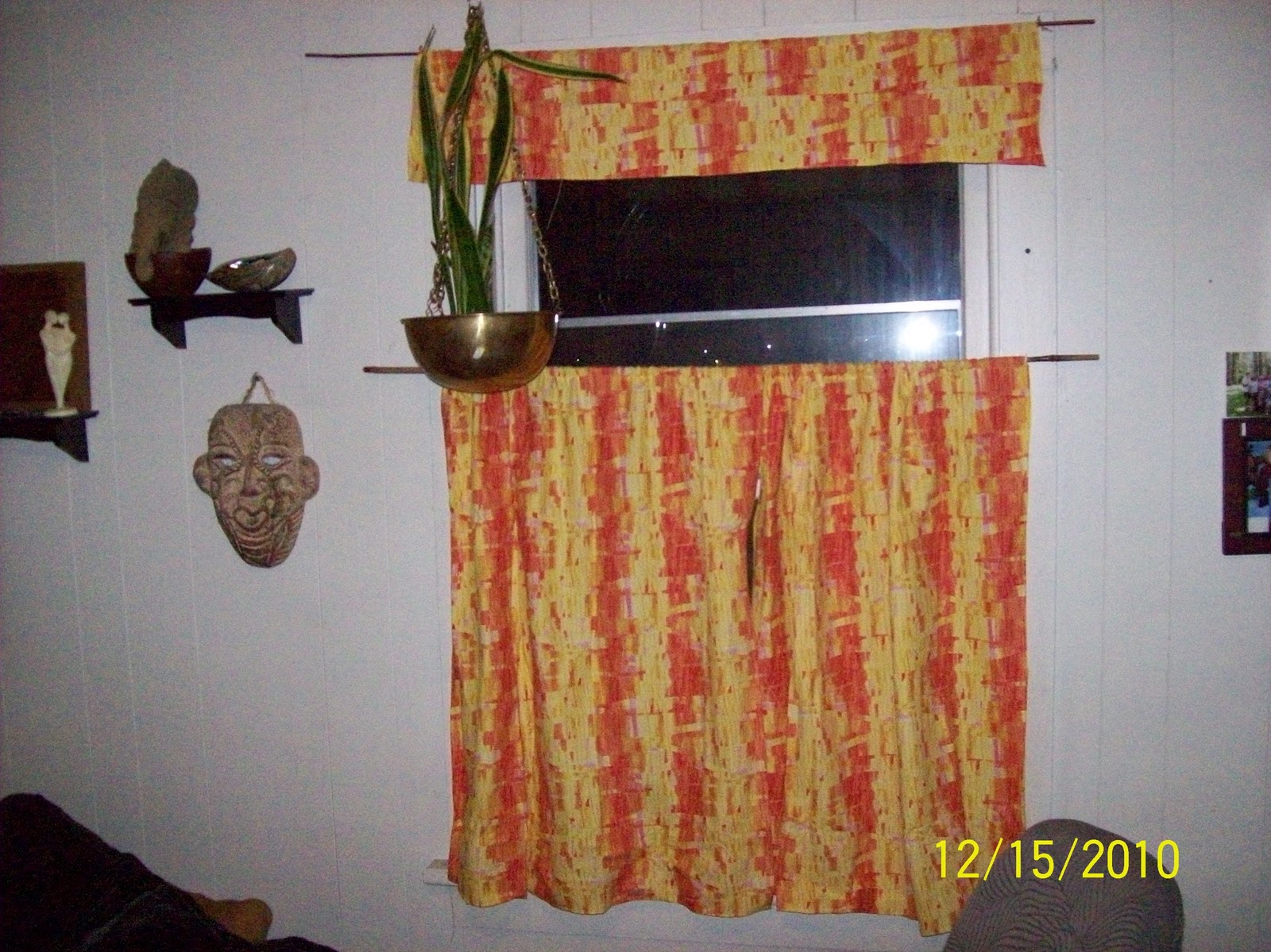
One project that's been sitting on the shelf is curtains.  We had very dark blue curtains that were disturbingly see-through at night when the lights were on in the house. We have a tiny house with bad lighting, so the dark curtains made it even smaller.  I've also been trying several ways to be able to keep plants without the cats either eating them or knocking them over.  So instead of waiting for money to buy fabric specifically for the project, I pulled out the bolts of quilting cotton once destined for drum covers. I made cafe' style curtains that give enough privacy, but let in plenty of light at the top.  I then hung plants from the ceiling where they could take advantage of the sun.  Between my fabric hoard and some bamboo sticks I'd bought to make a trellis (planned, priced, purchased, stuck in attic) I was able to make a major decorating change without spending an extra dime. 

The two yards of black pleather I found in a box made a rather hot and daring pencil skirt that I can't wait to wear to a party with my knee high boots.  I think I originally bought it for something punkish like the base for a skirt made of braided leather belts.  As for the brocade?  I have at least a few plans for dresses and jackets, but I may take at least some to make into a bodice for Ren-Faires.  Maybe even turn the rest into a nice luxurious quilt.  The point is that when inspired for a project, I need to look first to what I have before I decide I need to go out and buy more.

Tuesday, December 14, 2010

Gluten Free: First impressions and a comment on sugar

I've now passed my first week going gluten-free.  I've gradually realized that there really isn't such a thing as "substitute" when you're talking about such a complete change in diet.  While there are "flour substitutes," the magical formula with the same taste, texture and cooking behaviour as wheat flour is still out there, somewhere, beckoning me forth.  What I've realized is that I can't think of things as substitutes for foods I've eaten in the past if I want to learn to appreciate them for their own flavor and texture.  I have to think of them as what they are: new foods. 

Otherwise it feels way too much like a weight-loss diet, which means the change won't be sustainable.  Deprivation almost never is.  It also means it's triggering all kinds of weird psychological deprivation/binge issues that I know so well from my weight-watchers days.  Sorghum "substitutes" for the flavor of wheat in the same way fat-free carob "substitutes" for chocolate.  It doesn't, which means the craving isn't satisfied and neither am I.  In this case, I don't have the choice to satisfy my bread craving at home because of the risk of cross-contamination from crumbs, etc.  I can eat bread away from home (i.e. keep crackers in my desk at work) or I can keep practicing some gluten-free alchemy in search of the magic formula. 

A lot of the mixes and recipes I've tried so far have been poor substitutes, but it has taken me a week to pin down the reason; sugar.  White bread is sweet.  So are other things generally made from wheat flour.  So I make gluten-free pancakes from a mix expecting the light, fluffy, sweet taste of buttermilk and am disappointed when I get the heavy, semi-bitter, nutty whole-grain flavor of sorghum.  On the other hand, if I had come to the table expecting the flavor of whole-grain high-fiber pancakes I would have been fully satisfied and ecstatic over the results.   The gluten-free brownies aren't that good when I'm expecting the sweet milk-chocolate taste I'm used to, but are fantastic if I'm expecting the new, richer flavor of very dark chocolate. 

So going gluten-free seems so far to require a re-training of the taste buds and expectations similar to a change to whole foods.  Whole grain wheat products tend to have the same complex, semi-bitter flavor as what I've tried so far; probably because the flour "substitutes" are generally whole-grain.  Gluten-free foods also tend to be brands that omit super-sweeteners, like HFCS or artificial sweeteners (which we try to avoid anyway) to appeal to a whole-foods market.  People with Gluten intolerance also seem to tend to have multiple sensitivities so GF foods tend to keep it simple. 

Whether it's training or nature, my taste-buds are sensitive to bitterness.  One of the reasons I hate tomatoes is that I can taste a nasty, bitter flavor in even the sweetest hothouse grape tomato. Ditto with many whole-grain products, rye bread, etc.  This new gluten-free change is either going to require me to retrain my taste buds or work that much harder to find recipes that satisfy my taste cravings.

Monday, December 13, 2010

Happiness is: The Designated Control Freak Rule

This rule says, basically, whoever cares enough to want it is in charge of making it happen. 

In our house, there's rarely a dispute over who is in charge of what.  Now this could be because my partner is wonderfully laid back and patient, so he may just not be telling me when my skimping on the vaccuuming bothers him.  Or it could be because of the way the chores have settled between us. 

We discovered fairly early on that a neat, clean house was more important to him than it was to me.  I enjoy a clean house, but it isn't as high a priority on my time and energy as many other things.  I've always operated on the "blitz" method, where I periodically decide I'm sick of the mess and take an entire day to deep clean.  He's much better at daily ongoing maintenance of a clean house, and I'm learning to adapt to his better cleaning habits.

But there's no "if you love me you'll do the laundry this way because you know it's important to me" passive-aggressive nonsense. He knows that I'll put off laundry until I'm actually out of underwear (and even then sometimes I'll wash one pair in the sink rather than do a load).  I will also habitually leave most of the clean clothes in the basket until I've worn it all again, rather than put them away.  He has fewer clothes than I do and is much more concerned about how they're cleaned and put away.  One way he could theoretically handle this conflict of priorities would be to stand on "your turn" principles, nag me about getting it done, then get disgruntled if I don't do it "correctly".  Under the designated control freak rule, he simply does the laundry.  This may mean more work for him, but it means less nagging, conflict, and aggrieved but ultimately pointless discussions about when to add the fabric softener.  It means more peace and fewer resentments. He considers that a win-win situation.

Of course this can't work one-way.  There has to be give and take between adults, and some personal responsibility.  If one person is doing all the work then the couple or group may need to consider whether their needs and priorities are compatible.  And, of course, while it's generally good to give kids some choice in which chores they're in charge of, giving them full freedom to do nothing hasn't ever worked to my knowledge.

So my partner does the laundry and dishes.  He also wears shoes in the house and I like to go barefoot, so I'm in charge of vaccuuming.  It bothers me more to feel "grit" on the carpet. That's my Designated Control Freak.  I also like to dust, so that's mine.  I'm a germaphobe and actually like the smell of bleach, so the bathroom's mine as well.  He works at home during most days and hates looking at clutter, so general "picking up" usually happens before I get home from the office. 

I suppose you could argue that we're lucky in a lot of ways.  After all, our Designated Control Freaks don't conflict that often and we're able to settle it pretty amicably when it does.  We've made sure to "check in" periodically to make sure we both feel like we're contributing equally and the burden isn't all one direction.  It ends up working out according to our cleaning habits; he does the daily tasks and I do the periodic ones that can be moved a few days in either direction.  Win-Win.

Designated Control Freak comes down to personal priorities.  Is having something done a certain way more important than arbitrary divisions of labor?  Do you get more peace of mind doing it "correctly" yourself, for yourself, then trying to get someone else to do it for you?  Then consider simply doing for yourself, and find some peace of mind in the process.